
Where the Second-Home Math Actually Works
The second-home market is, in the end, an arithmetic problem dressed in a lifestyle photograph. You are asking three questions at once. Can I afford to keep it open all year. Will it be there in twenty years.
And does my life actually change when I am in it. For a North American or European buyer doing that math today, a Pacific beach community in Panama is one of the very few places where the answers line up in the same direction.
This is not a brochure. It is a comparison Pacific Panama against the obvious alternatives and an honest account of where each option breaks down. Buy with eyes open or do not buy.

The Florida Benchmark, and Why It Is Shifting
For decades the default second home for a Canadian or American snowbird was Florida. The math worked because the dollar and the legal system were home, the flights were cheap, and the carrying cost looked manageable. That math has changed.
Insurance premiums in coastal Florida have moved from a line item to a deal-breaker in much of the state. Hurricane exposure is no longer a once-a-decade tail risk for the insurance industry it is repriced annually, and many carriers have simply left.
Property taxes in popular counties have followed property values. Inventory has tightened. And the lifestyle the original Florida buyers bought in the 1980s and 1990s quiet, low-density, affordable is not the lifestyle the current Florida market sells.
None of which makes Florida a wrong answer. For some buyers proximity to family, language, familiarity it remains the right one. But the gap between Florida and the next-best alternative has closed dramatically.
What Pacific Panama Offers, Specifically
Several things, in order of how much they matter to most buyers.
USD as the Currency
Panama uses the US dollar alongside the local balboa. For an American buyer there is no FX risk. For a Canadian or European buyer the FX risk is to the dollar — the same currency their stock portfolio is mostly priced in. There is no peso, no quetzal, no devaluation overnight story to lose sleep over.
Outside the Hurricane Belt
Panama sits below the Atlantic hurricane corridor. It is the structural reason the country has never developed the kind of seasonal hurricane economy you find in the Caribbean and the Gulf.
Storms reach Panama as weather, not as named events. Insurance markets price that difference accordingly. It is the single largest reason carrying costs are lower than Florida.
Climate That Is Usable Year-Round
The temperature on the Pacific coast runs 24 to 31 degrees Celsius most of the year. December through April is the dry season sunny, breezy, cooler nights. May through November is the rainy season, with September and October the wettest. The rains arrive in afternoon storms and leave again.
Mornings stay usable. This is different from Florida summer, which is a heat blanket with no off switch, and different from Caribbean wet seasons, which can stretch over weeks of grey.
Freehold Ownership for Foreigners
Panama allows foreigners to own real estate outright, in their own name, in nearly all of the country. There is no leasehold workaround, no nominee structure, no requirement to hold land through a Panamanian partner.
Some specific coastal zones have rules of their own, but the standard Pacific beach buy is a clean freehold purchase, registered to you, transferred through a Panamanian notary.
A Territorial Tax System
Panama taxes Panamanian-source income. Foreign-source income your US pension, your Canadian dividends, your remote-work salary from a foreign employer is not taxed in Panama.
This is not a loophole. It is the structural design of the system. We always tell buyers to verify with a cross-border tax professional in their home country, because how their home country taxes them is a separate question. But the Panamanian side of the math is unusually simple.
Versus Costa Rica and Mexico
The honest comparison is not Panama against the United States. It is Panama against the other tropical second-home markets that North American buyers consider.
Costa Rica
The closest comparable. Stable, beautiful, an established expat presence on the Nicoya peninsula and the Caribbean side. Costa Rica is further along the maturity curve than Panama, which is both an advantage more services, more familiar and a disadvantage more expensive, busier, and the easy entry points are largely already gone.
The colón is the local currency, which adds an FX layer. Healthcare is good. Property law is good. The headline cost of a beach home is generally higher than equivalent Pacific Panama. A lot of buyers we meet looked at Costa Rica first and ended up in Panama for the dollar and the price.
Mexico
Bigger, more varied, much closer to the US. Some of the best second-home value in the Americas. The honest concerns most North American buyers raise are not about Mexico the country they are about specific regional safety issues and the legal structures that surround beachfront ownership for foreigners (the fideicomiso bank trust required in the restricted zone).
Panama avoids both of those, which is not a knock on Mexico so much as a structural difference. For some buyers the Mexico flight time and price-per-square-metre win the argument. For others the freehold and the dollar tip it to Panama.
Why Coco Beach Specifically
If you have narrowed it to Pacific Panama, the next question is which beach. The country's Pacific coast is long. The big established expat clusters are Coronado and Pedasí well known, full of services, and priced accordingly. Coco Beach in Puerto Armuelles is something different.
Coco Beach is further west, in Chiriquí province, about an hour from David and its airport. It is a quieter community, with fewer services than Coronado but a much more village-paced rhythm.
It sits on a wide Pacific stretch with a working town nearby. The expat community is small, the cost of carrying a home is meaningfully lower than the central coast, and the beach itself is, by most measures, better.
We go deeper into what makes this stretch of coast work as a build and ownership location in Panama's Hidden Gem: Why Coco Beach Is the Perfect Escape for U.S. Retirees and Digital Nomads, if you want the regional context.
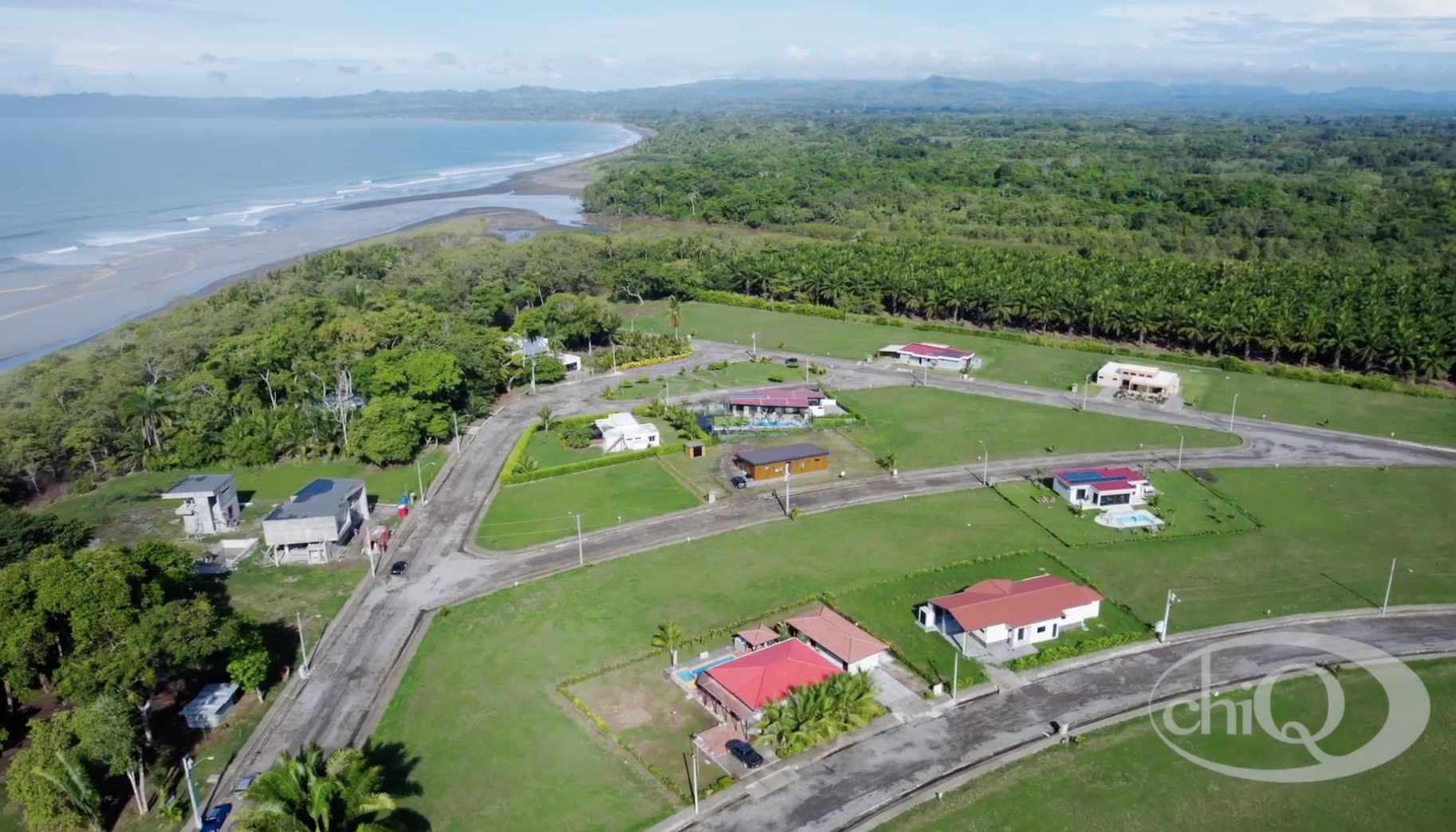
The villas at Coco Beach were built as a community by ChiQ Invest SA, a Dutch investment fund, with a Dutch architectural partner. The three completed villas about 210 square metres each, three bedrooms, two and a half bathrooms, solar-ready and with their own water treatment are move-in ready.
There is no construction risk to underwrite, no land to clear, no permits to manage from across an ocean. That matters more than it sounds when you are buying a second home from another continent.
The Honest Trade-Offs
A second home in Pacific Panama is not the right answer for everyone. The things to know:
You are further from family. A flight to David from most North American cities is one stop, typically through Panama City. From Europe it is two stops. This is the real cost of the lower carrying cost and the better climate. If a quick weekend visit is important to you, Florida or coastal Mexico wins.
The lifestyle is village-paced. Puerto Armuelles is not Coronado and Coco Beach is not Miami Beach. If you want a busy restaurant scene, a packed social calendar, and shopping you do not have to plan for, this is the wrong coast.
Spanish helps. The expat community speaks English. The town does not always. Basic Spanish makes the day-to-day meaningfully easier.
The rainy season is real. Six months of afternoon storms is part of the year. Most second-home owners optimise their visits for the dry season and rent out, lend out, or simply let the house stand during the wet months. The villas are built to handle the climate. The lifestyle preference is a separate question.
Who This Actually Works For
The clearest fit is the buyer with two or more of the following: a flexible work or retired schedule, comfort with travel, an instinct for places that are still finding their level rather than already at it, and a tolerance for village rather than resort.
The buyers we see most often are pre-retirees in their fifties and sixties looking for somewhere to spend winter, remote workers in their thirties and forties looking for a base in dry-season weather, and Dutch and German families building a long-horizon Atlantic-to-Pacific lifestyle play.
If the description fits, the math is unusually favourable for the next ten years. If it does not, no comparison will fix that.
Frequently Asked Questions
Can I really own a beach home in Panama outright as a foreigner? Yes, in nearly all of the country, including the Pacific coast. The purchase registers in your own name through a Panamanian notary.
A handful of specific coastal land categories have their own rules your lawyer will check on any given parcel, but the standard Coco Beach buy is freehold.
Is the USD really the currency in everyday life? Yes. Dollars and balboas circulate at parity. Pricing is in dollars. ATMs dispense dollars. There is no exchange friction for an American buyer and a flat dollar exposure for a Canadian or European buyer.
What does it cost to carry a Panama beach home compared with Florida? Materially less in most cases — insurance especially, given there is no hurricane exposure, and property tax is comparatively gentle. We do not quote specific premiums here because they vary. The principle is what matters: Panama removes the structural cost driver that has made Florida expensive to hold.
How do I get to Coco Beach from the US or Canada? Fly to Panama City (PTY), connect to David (DAV), and drive about an hour. From most North American cities the total travel day is comparable to a Florida-to-California flight day.
Is it a good rental market? The dry season December through April is the strong rental window. Outside that, occupancy is lower. Many owners cover a meaningful share of the year's carrying cost with dry-season rentals and use the rest of the year personally. The mathematics differ by property and we treat them honestly in our owner conversations.
What happens if I change my mind later? Resale works the same way the purchase did — through a notary, registered in the public registry. The Pacific coast resale market is thinner than Coronado, so good homes do sell but the timeline is real-estate-normal, not instant.
If the Case Adds Up for You
The clearest next step is to look at what is actually available now. You can browse the Coco Beach villas currently on the market, or if you would like a longer conversation about whether a Pacific Panama second home is the right fit, get in touch and we will walk you through it.





Comments